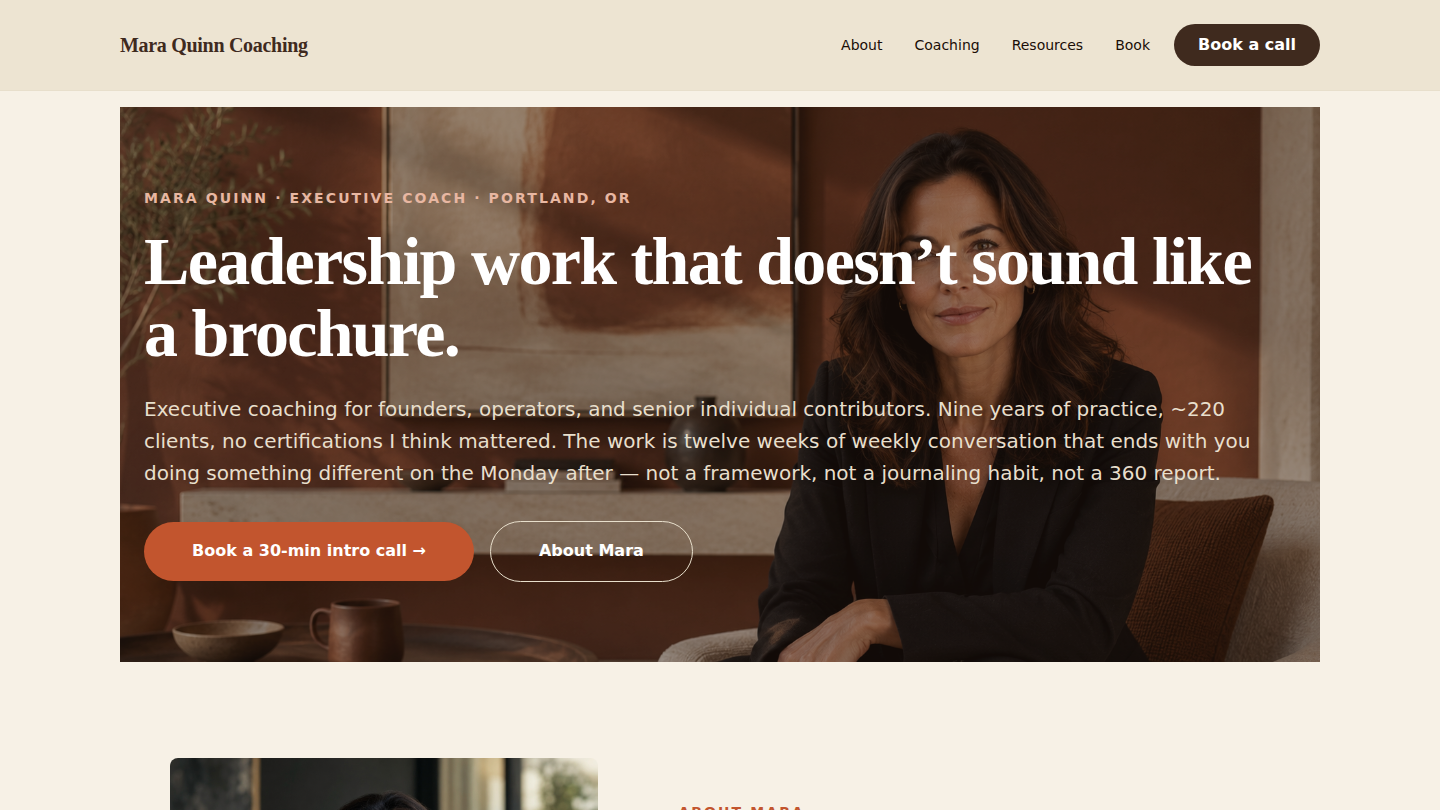
A fictional executive coaching personal-brand site — Mara Quinn Coaching — built to argue that WordPress is the right stack for the single-practitioner / personal-brand request that lives uncomfortably between Squarespace templates and bespoke Webflow builds. Twelfth demo on the platform and the fourth of the Tier 1 batch. Live at coach.wp.philiprehberger.com.
The challenge
Coaches default to one of two failure modes online — the wellness-mystic template (“transform your leadership presence”) or the funnel-by-default landing page that gates pricing behind a “discovery call.” Both treat the prospective client as a lead to capture rather than a peer to talk with. The result reads as either spiritual marketing or sales-call bait; neither communicates what the work actually looks like or what a session would cost. The genre’s prevailing convention is that a coaching site’s job is conversion to an intro call; the prospective-client reality is they’re trying to figure out whether this specific coach is worth their forty minutes and \$5,000.
The narrative confuses “coaching shopper looking for a methodology” with “operator looking for a specific person to think with for twelve weeks.” For the latter — which is most of the work an established coach actually wants — the right site looks more like a long-form personal essay than a sales funnel: who the coach is, what they did before coaching, who they work with and (importantly) who they don’t, what an engagement actually costs. Mara Quinn is the worked example.
The approach
A per-demo theme (coach) on the platform chassis with no new shared block — fourth time this Tier 1 batch we’ve made that call. The theme owns its identity: deep brown primary (#3F2A1E), warm terracotta accent (#C2552E), bone background (#F7F1E6), Fraunces serif for headings against Inter for body. This is the only Tier 1 demo with a serif heading treatment and the only one whose primary visual is a single editorial portrait of the coach. The chassis carries the editorial register without per-demo typography overrides — useful proof that the platform handles personal-brand work without forcing the demo to fight the parent theme’s defaults.
The pricing-honesty discipline that runs through all four Tier 1 demos shows up here as flat-rate engagement pricing visible on the Coaching page. $5,800 for the twelve-week 1:1 arc; $22,000 for the two-day leadership offsite; $6,500 for the career-transition quarter. Most coaching sites gate pricing behind the discovery call as a deliberate funnel mechanic; Mara’s coaching page puts the numbers in italics under each engagement description. The pricing honesty is what separates a credible single-practitioner site from a funnel-by-default landing page — and the discipline parallels the legal demos’ representative-matter dollar figures, the roofing demo’s cost ranges, and the dental demo’s procedure pricing.
What’s on the site
- Home. Brown cover hero with name + tagline (“Leadership work that doesn’t sound like a brochure.”), an about teaser block with the editorial portrait beside a “Operator first, coach second” intro, a three-up engagement preview, a
sfp-blocks/trust-stackresults bar (9 years · 220+ clients · 38 cohorts · 30-min intro call), and three testimonial cards with rounded avatars and first-name + role attributions - /about/. Long-form bio across four H2 sections (Operator first, Coach second, Who I work with, Where to find me when we are not in a session). Names the actual operator background (“three early-stage companies between 2009 and 2017 — a marketplace, a SaaS analytics tool, a consumer-health pilot that ultimately did not work”), the explicit “no ICF credential, no Hogan certification” honesty, and a “who I refer out” paragraph that says no to early-career IC, sales leaders, and people outside tech
- /coaching/. Three alternating image-text rows for Executive 1:1, Leadership offsites, and Career transitions. Each row carries a substantive description — what the engagement actually looks like operationally — and a flat-rate-pricing paragraph in italics
- /resources/. Two lead-magnet PDF covers (The Clarity Sprint, The Feedback Loop) with descriptions, page counts, and “Email me for the PDF” buttons. Explicit “no list signup unless you opt in” copy. Plus a quarterly-essays callout for the back catalog with three sample titles dated to the past nine months
- /book/. Email-only contact card (no phone, no Calendly, no scheduling widget) with a “what the call is and is not” callout that screens out sales-call-style entries (“It is a real conversation about the work in front of you. It is not a sales call. There is no pitch deck.”). The thirty-minute intro call is presented as a peer conversation, not a funnel stage
- Demo banner across the top making it explicit that Mara Quinn is fictional
The stack in detail
_chassisparent theme — templates, parts, patterns, gotcha-busting CSS, filemtime-based stylesheet enqueue. Inherited from the platform via symlinkcoachper-demo theme (this repo) — declaresTemplate: _chassis, ships the terracotta + brown + bonetheme.json, Fraunces serif for headings + Inter for body, customparts/header.htmlwith permanent “Book a call” pill +parts/footer.htmlwith practice bio + nav + email + working-hours windowsfp-blocks/trust-stackon the home page for the results bar. No new block authored, deliberately — the testimonial trio with rounded avatars uses core/columns + image + heading + paragraph; the engagement cards use core/columns + image + heading + paragraph- Four
sfp-*mu-plugins inherited from the platform;coach-banner-config.phpfilters the demo banner copy for the personal-brand / single-practitioner copy - WordPress 6.x · PHP 8.3 · MySQL 8 on Apache 2.4 (the same EC2 t3.small that hosts every other demo on the hub)
.scripts/seed-pages.sh— idempotent five-page seed. Generates a wide brown-bone hero, a square editorial portrait card with “MQ” monogram, a lifestyle wide shot, three service tiles, two PDF-cover resource tiles with “PDF” tag, and three terracotta-circle testimonial avatars via ImageMagick. Uploads viawp media importwith the standard<name>-imageattachment-slug rename; creates or refreshes all five pages; pins Home as the front- Standard repo additions:
needed-images.mdin the repo root specifying every image slot the demo expects (11 site content images, the avatar-style testimonials documented as a new generator), and.scripts/capture-portfolio-screenshots.shexposed asnpm run capture:portfolio
Where we made tradeoffs
Deferring person-card a fourth time. Four Tier 1 demos in, the deferral is now load-bearing. Each demo’s “team” affordance has shaped itself genre-specifically: lawfirm wanted attorney bios with bar admissions, dental wanted a four-person care team with rounded thumbnails and brief role labels, coach has a single hero portrait + three testimonial avatars (the “team” page doesn’t even exist on this demo). A shared person-card block would have to cover all three plus whatever the next demo brings — an abstraction with no real consensus shape. Defer until a real client engagement names the actual schema.
Flat-rate engagement pricing visible on the page. The funnel-by-default move would be to gate pricing behind the intro call (“Investment varies by engagement; book a discovery call to learn more”). The Tier 1 discipline of being honest about cost won out — same call we made on legal representative matters, roofing cost ranges, and dental procedure fees. The cost of showing pricing is that some intro-call requests don’t happen because the prospective client self-disqualifies on price; the benefit is that the calls that do happen are with people who already know the engagement fits their budget and are now evaluating fit. For a single-practitioner whose calendar is the constraint, that math is obvious.
Email-only book page; no Calendly widget. Every coach’s consultant friend will tell them to put a Calendly link on the book page so people can self-serve. We did the opposite: an email-only contact card plus a “what the call is and is not” callout. The Calendly-link version is right for a coach whose constraint is the volume of intro calls; the email-only version is right for a coach whose constraint is the fit of intro calls. Mara’s constraint is fit; the email step screens out the prospects who would not have made it past the first ninety seconds anyway, and keeps the calendar from being booked by people who clicked impulsively. A real-client engagement might want a Calendly link, in which case it’s a single-button addition to the book page — the structure carries.
Outcomes
- Five-page personal-brand site live at coach.wp.philiprehberger.com, end-to-end provisioned via the platform’s
provision-demo.shscript - Lighthouse: 98 / 96 / 100 / 92 (perf / a11y / best-practices / SEO) with placeholder photography. Within a point of the platform ceiling without per-demo tuning
- Greenfield-to-live in approximately four hours including the per-demo theme with serif headings (a new typography choice not previously used on the platform), the full five-page seed with flat-rate-priced coaching content, the case-study writeup, the hub Project registration, and the portfolio surfacing
- Fourth consecutive Tier 1 demo to ship without a new shared block. The deferred person-card and before-after-slider stay queued for a real client engagement to drive the design
- First Tier 1 demo with a serif heading treatment — Fraunces for headings, Inter for body. Useful proof that the chassis carries the editorial / single-practitioner register without per-demo typography overrides; pattern available to any future demo where a serif voice serves the genre
- Flat-rate engagement pricing on the Coaching page completes the Tier 1 pricing-honesty pattern: legal representative-matter dollar figures, roofing cost ranges, dental procedure pricing, coaching engagement rates. Four for four. Established as the platform’s standard service-business pricing-transparency norm
- Twelfth demo on the platform; eleventh consecutive demo since pulsar to ship the per-demo-theme + shared-platform split as the standard pattern. Identity lives in the demo, primitives live in the platform, neither side has to compromise